I was raised in Los Angeles, the daughter of a world-class violinist who played with the Los Angeles Philharmonic. My father had bipolar one disorder and we were very close. Back then I was a happy-go-lucky teen who did well in school and ran cross-country. No one suspected that I’d be diagnosed with bipolar disorder in my late-thirties.

I graduated from the University of California with a degree in literature and I became a freelance writer. I interviewed mental health luminaries Dr. Kay Redfield Jamison and Dr. Martha Manning for magazine articles about depression and exercise. I pursued my dream to become a certified personal trainer and led a healthy lifestyle.

At age thirty-seven, after the birth of my second child, the combination of genetics, sleep deprivation and hormones triggered postpartum mania and the rare condition of hypergraphia (compulsive writing). Six weeks after my daughter’s birth I was diagnosed with postpartum onset bipolar one disorder (PPBD) and was hospitalized. Over the next seven years, I endured multiple hospitalizations, medication trials, and rounds of unilateral and bilateral electroconvulsive therapy which helped pull me out of severe bipolar depression.

In 2013, I found a psychiatrist who was a good fit. With his guidance I developed a regimen of five key ways to keep me stable: seeing my team (psychiatrist and counselor) regularly, medication, exercise, writing, and enough sleep!

After I was diagnosed, I felt so lost and isolated in my small mountain community. Despite struggling with depression, I founded the first DBSA Chapter of my county—that gave me purpose. I arranged interviews with local newspapers to inform them of the chapter, and to share my story of living with bipolar disorder. Through DBSA’s auspices I created and co-facilitated support groups where I met people with bipolar disorder who have become close friends. I’ve benefited from online support as well through Facebook bipolar-themed groups.

In 2014 I became an International Bipolar Foundation blogger, and was honored to have my story be selected for IBPF Story of Hope and Recovery. During my years of bipolar depression, I never would have dreamed such a great thing could happen to me.

These days I’m working on my book, Birth of a New BrainHealing from Postpartum Bipolar Disorder with a foreword by Dr. Walker Karraa.  Writing this book is a true labor of love, but it’s incredibly challenging. The discipline required to write lends a positive structure to my days. My blog, Birth of a New Brain, gives me the opportunity to connect with a wonderful virtual writing community and I get valuable feedback on my writing. I was thrilled when, after discovering my blog, bestselling author/advocate, and my now writing mentor, Wendy K. Williamson (I’m Not Crazy Just Bipolar and Two Bipolar Chicks Guide to Survival) nominated me for the WEGO Health Activist Best in Show Blog Award.

I believe that anything is possible when it comes to living with bipolar disorder, and that we can reach stability with the right support and tools!  Accolades are the icing on the cake, and I appreciate them, but what matters most to me is keeping stable for the long-run.  If I’m well, I can continue helping other people who live with bipolar disorder, which is therapeutic for me too!

I was stuck in the morass of depression for so long that I didn’t think I would pull out of it.  If you’re in that place, please don’t give up.  I know this will sound like a cliché, but reach out to others. Seek a therapist and/or psychiatrist. My Dad always told me that by the time I was older, a cure would be found for bipolar. Although that hasn’t happened yet, we shouldn’t rule out breakthroughs with the tremendous amount of research happening worldwide. In the meantime do all you can to get support. You don’t have to suffer needlessly—there is hope for each and every one of you!
My mental illness emerged at the very end of 2005 in December—two years into my marriage, but before kids came along. At twenty-six, I was at the top of my game as a creative staffing agency recruiter, enjoying married life, and building our first house. One week my husband was on a business trip and I was so wired I couldn’t sleep. For a week. This led to a manic episode that landed me in the hospital. It left everyone close to me, including the psychiatrist who treated me when I came out of the hospital, scratching their heads. No previous mental health history we could identify, and nothing that we knew of in our family.

After a few days in the psych ward, I took the rest of the week off from work, and returned to my job the following Monday, attributing the entire incident to the intense deficit of sleep.

But two weeks later the mania was back with a vengeance and I was hospitalized on Christmas Day, certainly one of the darkest days of my entire life.

One time was a shock, twice forced the reality of the situation to set in. My husband never left my side, even though he must have been scared to death. My parents, clearly devastated this was happening to their daughter who had been perfectly healthy her entire life, suddenly were thrown into dealing with two psychiatric emergencies in one month.

My life was turned upside down.

As you would expect, I began seeing a psychiatrist regularly. Once the doctor got the mania under control, the anxiety flooded my body. I tried to return to work while figuring things out, but the normal stress of my high-pressure sales job sent me into a debilitating tailspin. In March of 2006, I was diagnosed with bipolar type 1. Just three months after my mental illness broke through the surface of my life, I was forced to resign from a career I loved and excelled at to focus on getting well. This caused me to slip into the cold, gray hole of clinical depression, where I curled up for about a year.

I found myself consumed with fear, embarrassment and shame. Not because of anything I’d done. I felt these emotions because of society’s stigma towards mental illness.

Over the course of years of psychiatrists and meds and therapy, after two more hospitalizations and with the incredible support of my husband and family, I made it through. My best friends knew about my condition and what had happened to me, but I kept it hidden from everyone else because I was afraid of being treated differently.

The internet became a place of healing for me, as I found myself online reading about people who were overcoming mental illness. I was inspired to start a blog, and began writing my story. As I shared bits and pieces, it became clear that writing was helping me heal, and it was also showing me that I was not alone.

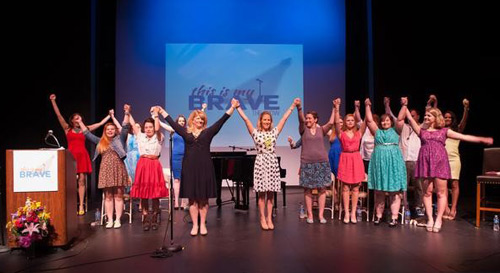
Last summer I had a vision of creating a theater production made up of real people from the community sharing their true stories of living with mental illness. I wanted to give them a voice. A way to express their pain, their journey to overcome stigma, and a way for them to inspire others to reach out for help. With an incredible creative partner, we launched This Is My Brave and through a successful crowdfunding campaign, raised the money we needed to make the concept a reality.

This past May, our cast took to the stage and shared their stories of living with mental illness through poetry, essays and original music in front of a sold-out audience.

Being able to take the mask off and reveal all parts of me, including the fact that I live with a mental illness, has been a tremendous factor in my recovery and continued stability. By talking openly about my illness, I’m breaking down stigma. There is power in sharing positive stories and bringing mental illness into the light, and my hope is that our non-profit will help many more people in the future the way it’s helped me.

I was born to a substance-addicted mother in a rough section of North Philadelphia, and was raised by my grandmother and step-grandfather. I was sent to a private school outside of my neighborhood because my grandmother didn’t want me to be influenced by the local kids, who were getting into any and everything that you could possibly imagine. Things were normal even though the household was in dysfunction. I was doing well in private school. But then, as I was getting closer to my middle school exit—I got sad one day and it never went away.

High school hit, and I didn’t shake this feeling. I didn’t fit in and my peers made sure to let me know it. I went from being an honor roll student to failing. I noticed that I was sad one minute, then happy the next. I went from having a normal sleep schedule to not sleeping at all, sometimes for days on end.

I told my family what I was experiencing. We tried mobile therapy; that didn’t work. With these feelings, coupled with the almost daily bullying and fighting, I was beginning to fall apart. I couldn’t grasp a thought let alone muster the words to explain everything that was going on. One day I wrote a suicide letter because I wanted out. I knew I needed help. No one believed me.

After high school, and deciding to skip my graduation, I was finally able to take myself to the doctor. I was hit with a diagnosis of bipolar disorder. What did this mean? I never got an explanation. I just got a prescription and was sent on my merry way. A year into my treatment, as I was slowly getting better, tragedy struck. My grandmother had a heart attack right in front of my eyes. During the time that she was in hospice, my mother, brother and I were told that we were no longer welcome to stay in the house. Just like that, everything was packed, and the night of the funeral we had to go.

I was sent to live with my aunt and uncle. After a few months, I was sent back to live in my hometown. Just like that, I became homeless and transient. I found myself on constant euphoric highs, and extreme depressive lows. I tried to support myself by working multiple jobs at once while continuing my education. I soon found myself bouncing from house to house. I felt like a burden and like no one cared. It wasn’t until I met the person who is now my best friend that things changed. She wanted to help me, so she took me in as if I was one of her own. She has been a constant in my life, and has helped me to move forward.

I am set to graduate in May of 2015 with my Associate of Applied Science Degree in Behavioral Health and Human Services, and, in June, exactly ten years after skipping high school graduation, I will receive a Bachelor of Science Degree in Behavioral Health Counseling. I am a member of an international honor society and an academic honor society, and currently hold a 4.0 GPA. I found my passion; I currently work as a Recovery Coach, providing peer support and hope to transition-aged youth and adults. I learned what has worked for me, what hasn’t. I have learned my triggers and how to counteract them. I have the best system that a woman can ask for, surrounded by the love of friends and classmates who root for me every step of the way.

I’ve come to realize that even though these things may have happened to me … it’s ok. Although these things may be fact—I am not these things. I’m more than just another face, another statistic, or person living with a disorder. I’ve been given a gift and have been selected to now sit on the other of the table to share my experiences. I’ve been through a lot; more than I would have liked to at a young age, but, I wouldn’t change it for the world. I am a survivor.

I want to say I lived each day, until I died, and know that I meant something in, somebody’s life
The hearts I have touched, will be the proof that I leave. That I made a difference, and this world will see
—Beyonce, I Was Here

When I found out I had been named the recipient of DBSA’s 2014 Life Unlimited Award, I was stunned. I would characterize my life as remarkable, but I also know each one of us is remarkable in some way. Each one of us is created for some kind of greatness.

I remember as a very small child believing that I was created for greatness. Somewhere along the way that inner voice was squelched. My home life had the normal dysfunction that many families have here in America. I went to college for a couple years and married at a very young age. Nearly a decade later, my mental health became unmanageable. I lost my home. I lost my family. I also experienced hallucinations and began to loathe myself and my life.

I tried ending my life more times, and in more ways, than I can remember. I was very angry with God for not letting me die. I couldn’t escape from the pain of this world so I began physically abusing my own body. I would lash out at myself in ways that I would never treat another human being, but I didn’t feel like a human being. I didn’t feel that I was deserving of anything good, let alone anything great.

Seemingly without warning, the trajectory of my life began to change. There were people who loved me when I wasn’t able to love myself. My Pastor would consistently say that “People are sacred creations of God”, and my Mentor taught me how to hold myself in unconditional high regard. I slowly began to fight for my life. Today I fight for life—my life and the lives of others—to the same extent as I once fought for death.

It was at a women’s conference when rumblings began to stir within me, within the depths of my soul. I remembered that voice from long ago which told me that I was created for greatness. Excitement crept back into my spirit. This expectation, the expectation that my life is of great significance, continues to shape my work as I move forward with the highest expectations. Today I serve as Founding Director of Sacred Creations, a statewide network in Illinois comprised entirely of persons with mental health conditions. I also work as an Associate Director for Pathways to Promise, a national interfaith organization which provides technical assistance to faith communities regarding mental health. My roles with both organizations have afforded my inner voice the opportunity to be heard nationally.

My life has value and meaning and purpose. I understand my identity. I understand my purpose. I know that I am created for greatness. This doesn’t mean that I don’t have challenges; I do. I have challenges every single day of my life. I still have unwanted thoughts of suicide, but it doesn’t impact me in quite the same debilitating way. I still have sensory challenges which make it very difficult to worship during a church service or concentrate when I am in an airport. Noise just hurts and I cannot escape it. In the midst of the chaos, there is something gained by continuing to move forward. I am still learning that whatever capacity I have for pain, there exists equal capacity for pleasure.

To me, Life Unlimited means that all things are possible. Life Unlimited means that I am moving forward in a manner which advances humankind. It means that all aspects of life have value because we have value. We were all created for some kind of greatness.

I was diagnosed with bipolar disorder shortly before my 30th birthday. Acutely manic, powerfully overconfident, and terrified that medication or even stability would kill my creativity, I refused to take meds.

When I fell into a crushing depression a few months later, I realized that no matter what happened to my art (my passion, my livelihood, my identity), my survival depended on stability. Desperate, I succumbed, and set out into the dark, tangled forest of meds, blood draws, side effects, and big learning curves.

After a years-long arc of frustrations and triumphs, recorded in stacks of sketchbooks and journals, I found a tentative stability that became increasingly reliable. I wanted to make sense of that overwhelming tangled mess, and I turned to my art to shape my experience into a graphic novel.

I’d never felt so much pressure on myself to get a story right. I needed that for my own psyche, but I also wanted to offer my story up to whoever might find something useful in it. I wanted to give specific tools I’d learned and made up, like the cognitive behavioral therapy exercise I’d found helpful and a lesson on how to swallow your pills in one gulp. I wanted to give other sufferer-warriors company, as Kay Redfield Jamison and William Styron had done for me in their memoirs, An Unquiet Mind and Darkness Visible. I wanted to offer myself as a scientific case study correlating mood disorders and creativity. I wanted to transform my negative experience into something positive. I wanted it to be a good book.

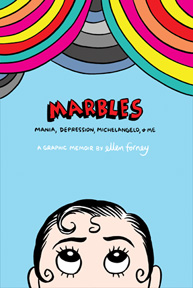
In January 2012, I turned in the final draft of Marbles: Mania, Depression, Michelangelo, and Me. It was a strange feeling: a combination of exhaustion, excitement and tremendous anxiety. I’d always been quiet about my bipolar disorder. What would happen when people found out? Would I be forever dismissed as crazy, untrustworthy? Would people be shocked? Would it be worse if they weren’t?

I learned something huge from putting my story out in the world: as I’d hoped, people told me I was giving them company, but I was given so much company, too. I was not a weirdo bipolar cartoonist specimen. Strangers, friends, readers, even interviewers would more often than not (I mean that) disclose their own personal experience with mental illness: their own diagnosis, their family history, their friend’s suicide, their son’s struggle. I didn’t know—couldn’t have known—how many chords my story could strike, or how many people were ready to be given an opportunity to come out.

Here’s the million-dollar question I get a lot: “Don’t you miss your manias?” The answer is very unsexy: “They’re not worth the risk.” No one asks if I miss my depressions!

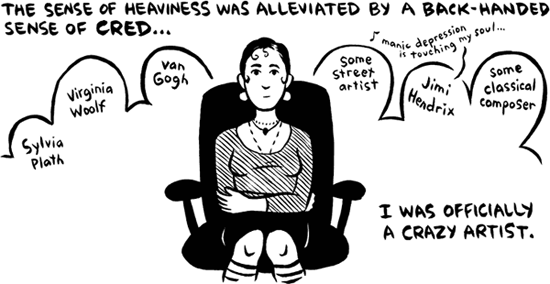
My own, originally unexpected conclusion about being a crazy artist is that stability is good for my art. Mania was too distracting to get much work done and depression was too stifling. My current meds don’t pin me down, and a healthy lifestyle of regular sleep and good nutrition doesn’t rob me of my punk rock.

Stability is relative—I’ll always live with bipolar disorder, and I’ll always need to deal with that. My latest trick involves my blood draws, which, after all these years, I still hate: I buy myself a fancy tea drink afterwards. (My current favorite is Matcha Mint Mate Soy Latte.) Now when I’m on my way to the lab, I think about my fancy tea drink. Pavlov knew what he was doing. It works!

YOU HAVE COMPANY. TREAT YOURSELF NICE. And: DO YOUR ART!

Seattle cartoonist Ellen Forney’s graphic memoir, Marbles: Mania, Depression, Michelangelo, and Me, is a New York Times bestseller, with six foreign editions. She recently presented her work as keynote speaker at the Comics & Medicine Conference 2014 at Johns Hopkins Medical Campus.

marblesbyellenforney.com
http://www.graphicmedicine.org/comics-and-medicine-conferences/2014-baltimore-conference/

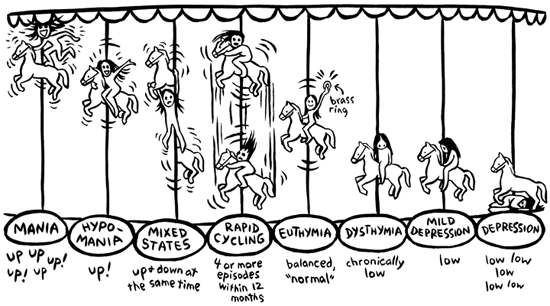
Images from Marbles: Mania, Depression, Michelangelo, and Me by Ellen Forney (Gotham/Penguin, 2012).

Could depression be a gift?

Beginning in 2000, I lived with a 5 year episode of depression which my psychiatrist described as the worst he had ever treated. Although I had experienced 4 major episodes of depression previously, this was in a different league. In a short time, I lost my job, my 20 year marriage, and became estranged from my 2 children.

I hadn’t accepted my depression passively. Over the course of 5 years, I tried 23 different medications, underwent ECT (shock therapy) on 20 occasions, engaged in cognitive behavioral therapy, and participated in many other programs for the treatment of depression. I also pursued many other alternative treatments, but the black thoughts, pitiful energy levels, and complete loss of confidence seemed terminal.

It got so bad that on July 24, 2004, I put pen to paper and said goodbye to my family. “I just can’t be a burden any longer,” I wrote.

Recovery one step at a time

It was a long path back from the brink, but medication helped me start to sleep normally again, which was an important first step. I started walking, which wasn’t easy initially. I gradually built it up to 45 minutes a day, 6 days per week. I realized that I had been spending a lot of time inside, and getting fresh air regularly was very rejuvenating. As my mood improved slightly, I made a conscious effort to meet a few people for a walk or coffee. Even though I didn’t look forward to those meetings, I found that invariably I would feel a little better afterwards.

Meditation proved to be my next breakthrough. I completed a short course and experienced peace from my new daily habit.

The next step in my recovery was volunteering for an organization that placed people recovering from a mental breakdown to work with charities. I observed how well these people responded to working again. Suddenly they had a reason to get up every morning, to mix with people, and to make a contribution again. As their sense of self-worth grew, so did mine.

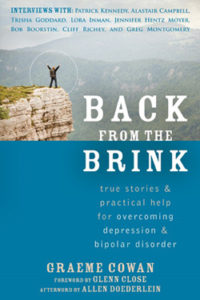
I began writing about my experiences and that of others who had overcome depression or bipolar disorder.  This eventually lead to my new book Back From The Brink, which I developed in partnership with DBSA. I interviewed former Congressman Patrick Kennedy, TV talk show host Trisha Goddard, and many others, who courageously described their recovery journey.

These anecdotal insights set me on another quest. I had personally felt frustrated that my mental health professionals focused mainly on medication and therapy, and so I decided to ask my fellow travellers “what worked best for you?”—this lead to some surprising findings.

Out of 60 options, fulfilling work rated number 6. To put this in context, cognitive behavioral therapy, the gold standard in mood disorder treatment, rated number 11, and the highest rating medication came in at number 23.

I became energized by helping those who were depressed discover the value of exercising, engaging with loved ones, finding great mental health professionals and fulfilling work. It is the most fulfilling work I have ever done.

As improbable as this seems, I now believe that my depression was a gift, because it forced me to make the truly important my first priority.

Based on the stories and research from my book, I have created a free 30 Day Mood Boost Challenge which provides people with one story and tip each day to hasten recovery. May the best in life and love and happiness be ahead of you.

THE POWER TO HEAL

If you walk about half a block down my street, you’ll see it—the locked treatment center for kids where I lived in the late 1980s. It’s hardly changed: a brick square of a building, unassuming, a few steps up from the street, a glass door that looks like any old glass door.

It’s not, of course. It’s locked, and it’s made of three layers of unbreakable glass. Once you’re let through that first door, there’s another one, also locked, and then another one, locked. I suppose if you went up the stairs, just any old person, you’d find that the door wouldn’t open, and you’d figure the place was closed.

Not so. One floor up, there’s Unit A, and two floors, more locked doors, and you’re at Unit B. I remember the click of those bolts into place as the last of the doors clicked behind me, and I realized that the locks weren’t to keep strangers out. They were to keep us in.

Nowadays, I look like your average neighborhood dweller, and I walk past the building often on my way home or walking my weird little dog. Nowadays, I glance up at the window on the top floor where, some twenty-five years ago, my snub-nosed, freckled teenage face was staring down. I was there because, back then, I was what authorities called “a problem child.” The kids in there knew better. We knew that really what we were—what the world thought we were—was just crazy. The leftovers of a broken system, a bunch of freaked-out kids that needed to be kept off the streets and away from the world. The world then—as, in many ways, now—thought that “troubled kids” were pretty much a lost cause before we’d even begun. The world assumed we were destined for a life of the streets, bums and bag ladies at best.

Well, what the hell did the world know? I mean, for Pete’s sake.

Now, the girls are let out at 2pm for a chaperoned walk around the park—I see them every day, and I remember the burst of hot, humid summer on my face when they let us out some rare afternoons (back then, they let us out to smoke!). Listening to them laugh, I remember us as giggly kids who were, in that locked world, safe from our own pain for the first time in our lives.

I want to talk to my former self. This is what I’d tell her, and it’s what I’d tell any kid with a mental health diagnosis now.

Look, kid. They don’t know what’s going on with you, and they won’t for years. So, just FYI, you’re no more crazy than anybody else—not one of you is crazy, as a matter of fact, and all of you are going to survive this hard time. You’ve got a brain disorder—and in twenty-some years, so much will have happened in science, medicine, and in your own life that the disorder will  be treatable, manageable, and you’ll describe yourself as a person in recovery. They don’t know yet that recovery is even possible for people like you. They’re going to think they can write you off.

So prove them wrong. Because by the time you’re grown, there will be millions of people like you, people who’ve survived a kind of hell, and come out the other side incredibly strong. And there will be a whole new generation of people for whom treatment is vastly more effective, a whole generation of people who won’t have to suffer nearly as long.

You can make it, kiddo. Just don’t give up. Not ever. You’ve got what it takes: you’ve got the power to heal.

Now begin.

Marya Hornbacher is an award-winning journalist and the author of five books, including the New York Times best-seller, Madness: A Bipolar Life. Marya is a DBSA Honorary Advisory Board Member.

I always knew something wasn’t right. Throughout childhood, I swung back and forth between states of high energy and low self esteem. As a young girl, I turned to self help books and inspirational quotes to try to fix what didn’t seem right. I could never understand why I didn’t seem like everyone else. I was a cheerleader and sang in the choir in junior high school. I always felt like an outsider.

In high school, I twirled a rifle in the marching band color guard and was editor of the school newspaper. I worked a job which filled my time, so I didn’t remember I wasn’t going to the dances or hanging out with friends. Life brought similar experiences in college and beyond.

It wasn’t until my second daughter was born that I felt time was running out. I needed to do something—anything—to fix this. It did not occur to me that I was another chapter in the history of my family’s mental illness.

My maternal grandmother was hospitalized and treated with shock therapy when I was a little girl. She was deaf, which made treatment difficult. I remember going to her doctors’ appointments with her and my mother. The doctor did not use sign language, or know how to communicate with her. She would speak to my mother, who would ask my grandmother how she was feeling. She was given her prescriptions and we left.

Although my mother never went to a doctor for mental illness, she had all the behaviors of someone who would have benefitted from mental health care. Unfortunately, she passed away at the age of 62. She signed her own papers to cease dialysis treatment for kidney failure, which was caused by late-stage diabetes.

Why I never associated my symptoms with my family history still confuses me. I can only attribute it to the stigma of mental illness which existed then, and still does, to some degree, today. Like many, I felt like I should just be able to snap out of it. After a few attempts at finding relief, I went to a psychiatrist. I started taking a medication which did improve the quality of my life.

Unfortunately, psychiatric care was not covered by insurance, so I only saw my psychiatrist once a year. In early 2012, I walked into my boss’s office and sat down and sobbed. I couldn’t take it anymore. I asked for time off, which was granted. I went home and called the employee helpline. I wanted to end it. The counselor on the phone found me a local therapist, who advised me to go to the hospital. I was entered into an outpatient program where I spent the next few months learning cognitive behavioral therapy (CBT) and dialectical behavioral therapy (DBT) techniques.

What I learned was life changing. Mental health care is just like dental care! I see my dentist a few times a year, but in between, I brush and floss daily. With mental health care, I see my psychiatrist a few times a year and a therapist when needed. I take my medications regularly and as prescribed. I practice what I have learned from CBT and DBT. In between the professional help, it is important for me to maintain a healthy lifestyle of eating well, limiting alcohol and caffeine, staying active, and getting sleep, as well as being mindful of moments that bring joy. I learned that I am the advocate of my own health, which is my future. I still have my low moments from depression and bipolar. It is a process of recognizing symptoms and avoiding triggersI have also learned to forgive myself for not being like everyone else. I have come to accept where I am right now and how much more life has to offer me in the future.

Today, I work full time and try to help others challenged with mood and mental disorders through my support group, Checkpoints Anxiety and Depression, and my involvement with DBSA Greater Chicago. I participate in advocacy with DBSA National in the hopes of making the stigma go away, and of mental health treatments being made available to everyone who is in need.

My message is simple:  You can be better!

SPEAKING OUT

If I had to pinpoint a time when I first felt the symptoms of depression—

the feelings of sadness, aloneness, and worthlessness—

I would say it was around the age of eleven or twelve. Sometimes the journey wasn’t all that bad, as when the symptoms were managed through medication and therapy. Sometimes the journey was very rough, however, and I spiraled downward into months-long episodes of major depression. The absolute low point of my journey happened during my junior year of college.

As I entered an episode of major depression, I started to isolate myself from friends and family. I chose to sleep rather than deal with my increasingly intense feelings of self-hatred and worthlessness. I avoided any social interaction because of the fear of judgment. I thought to myself, “If I don’t like me, how can I expect other people to like me?” So I spun deeper and deeper into a world I created for myself—a world which consisted only of me and my dark thoughts.

After living this way for a couple of months, I forgot what life outside of depression looked like. I felt like I had been having these thoughts and feelings all my life. I couldn’t remember a time when I wasn’t depressed, and I couldn’t imagine a future where I wasn’t depressed. I felt hopeless. When I became tired of trying to live and hold it all together, and when the thin string of sanity that I was holding onto finally snapped, I decided to end my life.

https://soundcloud.com/wbez/storycorps-chicago-college

But, thankfully, that’s not where my journey ended. I stayed in a psychiatric hospital for a week before entering an intensive day program for six months. During this time, I took a medical leave of absence from college, and focused on a new kind of education: learning to love myself and learning how to live with depression.

After graduating from the day program, I returned to college. It was important for me to prove to myself, and to those who supported me throughout my recovery, that my suicide attempt was not going to derail my life. I would not let it force me to compromise the goals I had set for myself.

I want people to know that I am not ashamed of my suicide attempt. I want them to know that there is nothing shameful about the feelings associated with depression. They are real and valid feelings, and ignoring or dismissing them is not the answer. For me, it took a suicide attempt for these feelings to come out, but it doesn’t have to be that way for other people.

Speaking openly and honestly—

without guilt or shame—

about my depression has taken my journey with depression in a new direction.

I continue to advocate and share my story in the hopes that knowing others have or are experiencing the same feelings can provide hope to teenagers and young adults. I have had the opportunity to participate in a program that provides mental health screenings to elementary and middle school; I recorded a StoryCorps interview with my mother that aired on my local NPR station and will be archived in the Library of Congress; and I will be a panelist at the Illinois Department of Public Health’s 2014 Statewide Suicide Prevention Conference. Excitedly, I will also serve as the co-chair of DBSA’s newly established Young Adult Council. All of these activities not only help to promote awareness and education about mental illness, but are instrumental in supporting my efforts to live a life of wellness.

My journey with depression will be a lifelong one. The journey isn’t over because I’ve learned tools and practice skills that promote living in wellness. Not every day is perfect; and some days, wellness is hard to achieve. However, life is beautiful and enjoyable once again because I’ve learned to accept and embrace this journey. And sharing my journey with others only makes it that much more rewarding.

CULTURE COUNTS

“I wish my son had cancer instead of depression” the mother of an Indian teenager I recently met said to me. “If he had cancer, I could at least share our pain with our family and friends, and ask them for help” she said, tears streaming down her face.

My heart breaks every time I hear about the deep sense of isolation many Indian families feel in supporting their loved one struggling with mental health issues. As an Indian woman who has struggled with debilitating anxiety and depression, I know first-hand the difficulties of overcoming the stigma of mental illness within the Indian community. Growing up in India, my family and I had no understanding of mental health issues. By the time I was 18, I was debilitated by undiagnosed generalized anxiety disorder and panic attacks. At 23, as a young mother in America, I struggled to free myself from the death-hold of depression. And, at 25, on a trip back home to India, I suffered a massive breakdown and became obsessively suicidal. Finally, my family physician recommended that my parent’s take me to a psychiatrist.

“I pray no one we know sees us here, Gayu,” my mother had whispered, scooting closer to me in the waiting room. “You never know the vicious rumors people can spread.”  Within minutes of examining me, the psychiatrist had diagnosed me with clinical depression. But, the diagnosis soon became a noose that threatened to destroy me and my family. Ironically, in India, where our national motto declares “truth alone triumphs” my family and I were terrified that my truth, my diagnosis of mental illness, will destroy us all.  So, we decided to keep my diagnosis a secret. And, my family and I lived like prisoners in our home, hiding behind a veil of shame and secrecy. Despite my return to the U.S. and access to the best medical care, I continued to suffer recurrent bouts of depression. Years later, after yet another failed suicidal attempt, I finally chose to be hospitalized. On April 30, 1989, Confined in the seclusion room of a psychiatric ward, stripped of freedom, dignity, hope and humanity, I promised to emerge a messenger of hope and healing. For every indignity that I had suffered in shame and silence, I promised to fight to restore my dignity and the dignity of others like me around the world. And for every moment that my family and I had lived in despair, I promised to bring hope to the lives of others like us.

Although my stay at the psychiatric hospital was traumatic at times, it was ultimately life-transforming. For the first time in my life, I met others like myself in the hospital, people with mental illness, and I realized that I was not alone. The caring staff, and the many educational opportunities and therapeutic interventions they offered, helped me pave my path to recovery. One day, one step at a time, with self-determination, hard work, effective treatment, and the unconditional love and support of family and friends, I have created a healthy, meaningful life. Today, as the Founder and President of ASHA International www.myasha.org a nonprofit organization promoting personal, organizational, and community wellness, and the author of my upcoming memoir Shadows in the Sun: Healing from Depression and Finding the Light Within, I am dedicated to helping others struggling with depression and mental health issues to overcome barriers to recovery and achieve wellness.

According to a recent article in India West by Sunita Sohrabji, the suicide rate among Indian Americans is on the rise. We are stressed, depressed, and struggling with other mental health issues. But, we don’t like to talk about it. Nor, do many of us like to seek help. Unfortunately, the cultural stigma surrounding mental illness sentences people into lives of shame, secrecy, and needless suffering, and prevents people from seeking life-saving treatment and support.

As a mother and mental health advocate, the struggles of families breaks my heart, and strengthens my resolve to promote mental health awareness, and bring hope and healing to people struggling with mental health issues and their families.  It is time we break the silence surrounding mental illness in the Indian community, and start the conversation about mental health If not for us, we have to do it for our children’s sake. Fortunately, organizations like the Depression and Bipolar Support Alliance, and ASHA International can help us get started.

Links

Stay Connected
Join our mailing list to learn about our upcoming programs, services, and ways you can become involved.