
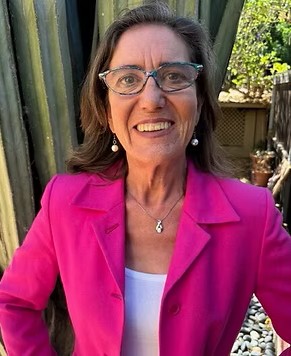
In 2000, Wendy walked into a DBSA support group at a crossroads in her life. What she found was more than support: it was a community that helped her imagine a future she once thought was out of reach. A longtime DBSA member, volunteer facilitator, advocate, and most recently a DBSA Create to Cope workshop facilitator, Wendy reflects on the people and connections that changed her life.
From Despair to DBSA
By Wendy Leigh McNeill Sizer
“It is better to walk together in the darkness than alone in the light.” –Helen Adams Keller (June 27, 1880 – June 1, 1968)
It was 2000. I was sitting in a circle. The bro at the helm looked like a clinician. He was sharp as a tack with a bland expression, but he claimed to have bipolar.
I sat rigidly in my seat and listened as ¾ of the circle introduced themselves: Name. Diagnosis. Digit. Topic.
One after the other… my name is so and so. I am bipolar. I am unipolar. I have anxiety. I have complicated grief.
Closer and closer came my turn.
Then the guy next to me spoke: George, bipolar. 3.5 on the pyramid. No topic.
My turn.
Before I could even blurt out my name, a primal scream came through me like a bomb detonating. I could hear myself sobbing as if I were having an out-of-body experience. Eventually, sentences poured out of me.
“My life is over. My mother dumped me in a Board and Care in El Cajon! She made me get rid of everything! I have roaches living in my digital clock! I have to wear shoes in the bathroom so I don’t get pee all over my feet!”
There was more. I finally subsided, and the meeting continued.
When the facilitator led the discussion back to me, as if by magic, the room came to my aid. “This is where I was…This is what happened to me…I’ve been episode-free for 8 years.”
What??? I’d never heard such a thing. Slowly but surely, the collective vibe reached my heart and touched my soul as if to say, “You’re here now. It’s going to be OK.”
And in 2026, I can say with certainty that it is. The first step jolted me into faith; there was a life for me somewhere in the great unknown. After that day, it became my religion to go to group every week, week in and week out.
I met Don, the man with the heavy Massachusetts accent who told me I could drink non-alcoholic beer and still have friends. I met Becca with the anklet and the perfect pedicure who had a Biology degree from Berkeley but still had to struggle with her demons. I met David, who smoked as profusely as I did, but it didn’t prevent him from getting married. I met people with jobs. I met people with friends. I made friends.
I met people that had more on the inside than on the outside.
That, in fact, was the miracle of DBSA: meeting people backwards. You knew the inner self before you ever learned that the bro was a Padre fan or that she liked to crochet.
So, where have I been since the early years?
I found my own place. I met a man. I got a job. I reconciled with my mother. I facilitated in the rooms that led me to my healing. I got married in the backyard of the DBSA matriarch.
I gave back, and in the process, the Universe paid me in kind.
I’ve also come to believe that no one gets well on a desert island. In community, we can find ourselves neither alone nor alienated. Together, we heal, and we mature. We move, sometimes forward, sometimes back, but we know that the room will always be there when we need it.
Thank you, DBSA. What a force for good you are!
Wendy is a longtime member of DBSA San Diego, where she resides. She attended her first meeting in September 2001, at a crossroads in her life, and promptly became deeply involved in the organization. In 2002, she became a Volunteer Facilitator, and in 2005, took the role of Community Liaison. In that role, she became one of the strongest voices of the community and stepped up as a mental health advocate. She is a believer in the power of group to facilitate recovery and promote quality of life for all people with mental health challenges. In 2020, Wendy published a volume of poetry in collaboration with a visual artist named Tiko Makunts. This work explores themes such as mental health in all its complexities and the many facets of human nature.